You might have noticed it’s been quiet around here. A few weeks ago my lower back went to hell and has been spasming and freezing up on me at the most inconvenient times.  Sheesh.
But onward. On April 4 I gave a talk at the Willamette Writers meeting in Portland about goals, motivations, and stakes in fiction. I cannot believe a whole month has passed, but then I cannot believe that it’s already May. It was a fun night and a delightful audience and I want to follow up with information for those who attended {thanks so much} and writers who don’t live in Portland.
More notes from my talk are now at the Willamette Writers site here.
If you’re familiar with my books or visit this site, you know that I work as a developmental editor. This means that authors and beginning writers send me manuscripts to edit and I help them shape the best possible story. Together we dive in and fix everything from plot holes to dialogue problems to voice. And I often spot troubles with character motivations, goals, and the overall stakes in the story. If these devices aren’t nailed down the story lacks credibility and plausibility. Sometimes writers patch up the holes with coincidences or with the conventions of the genre. For example if he or she writes suspense, well then his protagonist/detective is naturally assigned to the case and the case will be fascinating.
But a detective also needs a personal stake in solving the case–it cannot simply be a job or duty. Just as the detective needs an inner demon or trying circumstance to make the case particularly difficult to solve. Think about Clarice Starling trying to stop a serial killer in Silence of the Lambs while meanwhile she has the diabolical Hannibal Lector messing with her head. She’s forced to interact with him because innocent young women’s lives are at stake. Powerful motivation, right?
But a protagonist needs a reason for being a detective in the first place. This reason should be complicated, because everything in fiction is complicated and layered with meaning and entanglements. This means some events or circumstances in the past pulled the protagonist into this demanding field. And he or she has the right personality traits to take on the job. The detective might have a strong sense of justice, believes in protecting innocent lives. He or she might be dogged and smart and tough. Whatever it takes to solve the crime. Which brings us back to Clarice who was orphaned when her sheriff father was killed in the line of duty. She was sent to live on her uncle’s farm. One morning she was awakened by the horrible sounds of lambs being slaughtered and tried to save one by running away with it. We learn this seminal moment shaped her because Hannibal Lector, the antagonist, wrings the story from her.
So start with backstory and complex motives for your protagonist to be involved in the story’s main conflict. Then squeeze and torment him from all sides.
Another example is Atticus Finch in To Kill a Mockingbird. Atticus is an attorney and a just and decent man. He’s assigned the case to defend Tom Robinson, a man wrongly accused of rape.
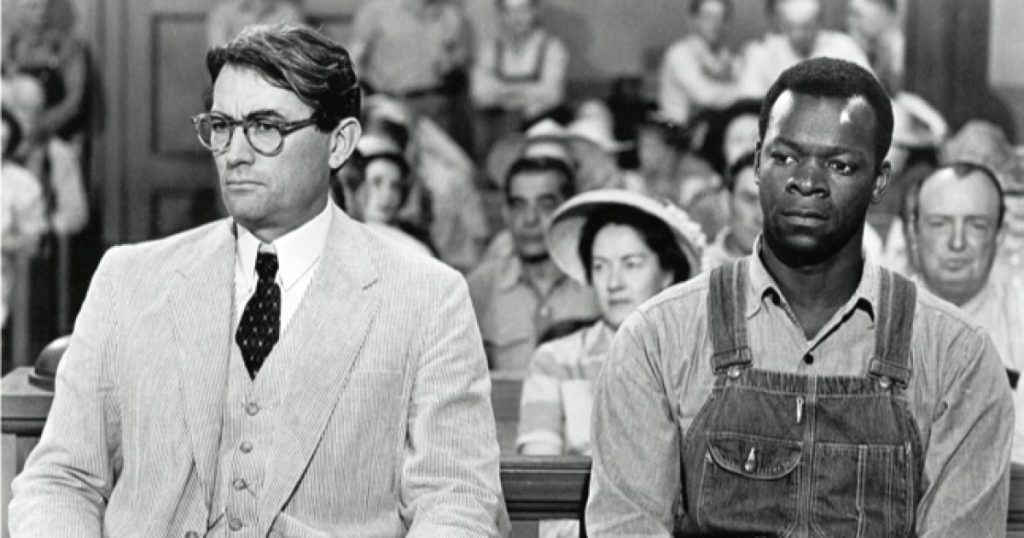
To Kill a Mockingbird (1962)
Directed by Robert Mulligan
Shown from left: Gregory Peck (as Atticus Finch), Brock Peters (as Tom Robinson)
Atticus realizes this case is going to bring out the worst in people in his community and he’s somewhat reluctant to take it on. But he believes in the law and he believes in Robinson’s innocence. He also knows he’s the best qualified person to do the job.
Atticus Finch is a beloved fictional character for many reasons. I believe the main reason is that he stands for something and he stands tall. What does your protagonist stand for?
To be continued…..
 Goals will define and test your characters. Goal by goal, scene by scene–because goals fuel scene–that’s how your protagonist proceeds through the story. Now, as I write this I realize it sounds kind of cold -blooded or formulaic. But wants, desires, plans, steps, contests, machinations, quests, searches, game plans, schemes, investigations, all propel a story forward. Make things happen. Invite conflict. Shake up the order. Involve the reader.


 Be a good steward of your gifts. Protect your time. Feed your inner life. Avoid too much noise. Read good books, have good sentences in your ears. Be by yourself as often as you can. Walk. Take the phone off the hook. Work regular hours. ~ Jane Kenyon